
1. Why is a Kidney Biopsy Needed?
Blood tests (such as serum creatinine) and urine analyses tell us that your kidneys are malfunctioning, but they rarely tell us why. The kidneys can be damaged by dozens of distinct immunological, inflammatory, genetic, or vascular conditions—each requiring completely opposite medical treatments.
For example, prescribing high-dose immunosuppressive chemotherapy to an adult with unexplained nephrotic syndrome without a biopsy could be ineffective or dangerous if the actual diagnosis is diabetic glomerulosclerosis or amyloidosis. A percutaneous renal biopsy provides the definitive cellular and immunological diagnosis, allowing your nephrologist to tailor precise, targeted therapies.
2. Key Clinical Indications for Renal Biopsy
Nephrologists recommend a kidney biopsy in specific high-stakes clinical scenarios:
- Unexplained Nephrotic Syndrome in Adults: Distinguishing between Membranous Nephropathy, Focal Segmental Glomerulosclerosis (FSGS), and Minimal Change Disease.
- Rapidly Progressive Glomerulonephritis (RPGN): A sudden, alarming loss of kidney function over days or weeks, suspected to be ANCA-vasculitis or Anti-GBM disease.
- Systemic Lupus Erythematosus (Lupus Nephritis): Classifying the exact histological stage (Class I through VI) to determine whether toxic immunosuppressants are warranted.
- Persistent Unexplained Proteinuria & Hematuria: Active urinary sediment with red blood cell casts suggesting IgA Nephropathy.
- Kidney Transplant Allograft Dysfunction: Differentiating between acute cellular rejection, antibody-mediated rejection (ABMR), and calcineurin inhibitor drug toxicity.
3. How the Procedure is Performed: Ultrasound Precision
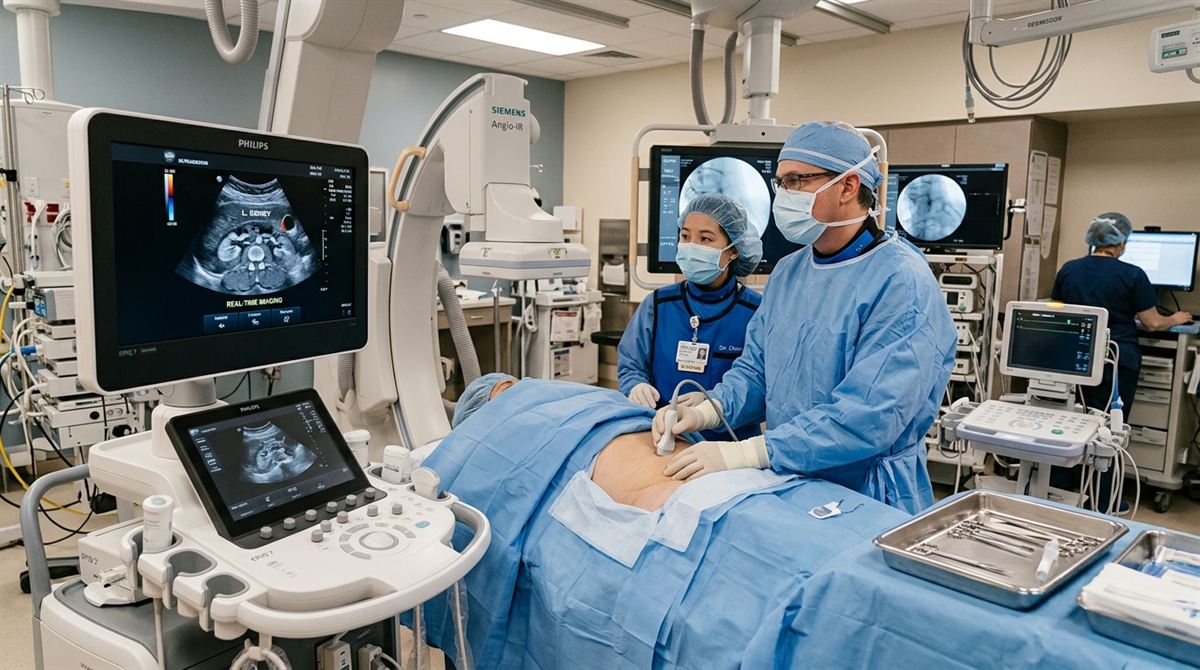
Many patients imagine a kidney biopsy as an open surgical operation. In reality, it is a minimally invasive percutaneous procedure performed in our specialized intervention suite at Fortis Escorts Hospital Amritsar:
- Patient Positioning: You lie comfortably on your stomach (prone position) with a small pillow under your abdomen to elevate the kidneys.
- Real-Time Ultrasound Guidance: The nephrologist uses high-frequency ultrasound to visualize the lower pole of the left kidney, mapping the exact depth, renal cortex, and avoiding major blood vessels.
- Local Anesthesia: Local anesthetic (Lignocaine) is injected to numb the skin, subcutaneous fat, and renal capsule. You remain completely awake and comfortable, feeling only gentle pressure.
- Automated Needle Core Extraction: Using an automated spring-loaded biopsy gun, the nephrologist takes 2 to 3 thread-like tissue cores (measuring approximately 1 mm wide and 15 mm long) from the superficial renal cortex. You are asked to hold your breath for 5 seconds during needle firing to keep the kidney motionless.
4. Safety, Risks, and Complications
When performed by an experienced nephrologist using real-time ultrasound guidance, percutaneous renal biopsy is exceptionally safe. Serious complications occur in fewer than 1% to 2% of patients:
- Microscopic Hematuria: Nearly all patients have harmless microscopic blood in their urine for 24–48 hours, which resolves spontaneously.
- Gross Hematuria (3–5%): Visible pink or red urine, which clears with oral fluids and bed rest.
- Perinephric Hematoma: A small pocket of blood outside the kidney capsule, typically reabsorbed naturally by the body over several weeks.
- Major Transfusion or Embolization Need (< 0.5%): Extremely rare in modern ultrasound-guided practice.
Nephrologist's Clinical Pearl — Dr. Fayaz Ahmad Wani
"Patients are often terrified when they hear the word 'biopsy', associating it with cancer. In nephrology, 95% of kidney biopsies are NOT done for tumors, but to diagnose curable autoimmune and inflammatory diseases. A biopsy replaces guesswork with microscopic certainty, enabling us to prescribe the exact right treatment that saves your kidneys from dialysis."
5. What to Expect After the Biopsy: Recovery Rules
- Mandatory Flat Bed Rest: You must remain lying flat on your back in hospital for 6 to 12 hours. The pressure of your body against the mattress acts like a natural compression bandage on the kidney puncture site.
- Vital Signs & Urine Monitoring: Our nursing team monitors your pulse, blood pressure, and urine clarity every 30 to 60 minutes.
- Discharge Next Morning: Most patients are discharged home the following morning after a normal post-procedure ultrasound check.
- Avoid Heavy Lifting for 2 Weeks: Avoid strenuous gym workouts, running, cycling, or lifting heavy objects for 14 days to allow the puncture site to heal completely.
📚 Peer-Reviewed Clinical References & Guidelines
- Renal Pathology Society Guidelines for Native Kidney Biopsy Handling ↗
- American Journal of Kidney Diseases (AJKD): Native and Transplant Kidney Biopsy Safety Review ↗
- KDIGO Clinical Practice Guideline for the Management of Glomerular Diseases ↗
- Fortis Escorts Hospital Amritsar - Interventional Nephrology & Biopsy Suite ↗
Frequently Asked Patient Questions
Does a kidney biopsy hurt?
The procedure is performed under local anesthesia, so you will feel a tiny pinch from the numbing injection, followed by a sensation of mild deep pressure. The procedure itself is not painful.
Can you live normally with the tiny piece of kidney removed?
Yes! A biopsy takes only about 20 to 30 microscopic nephrons out of the two million nephrons you possess. This tiny sample has zero impact on your overall kidney function.
How long do kidney biopsy results take?
Preliminary light microscopy results are usually available within 48 to 72 hours. Specialized immunofluorescence and electron microscopy stains require 4 to 7 days for complete sub-cellular reporting.
Related Kidney Health Articles
"Medical education empowers patients to make informed, life-saving choices. When we catch kidney decline early, modern nephrology has the tools to protect your kidneys for decades."
— Dr. Fayaz Ahmad Wani
MD (General Medicine), DM Nephrology (Osmania Medical College)
Senior Consultant Nephrologist & Kidney Transplant Specialist
Fortis Escorts Hospital ↗ & Primus Medicare, Amritsar
Medical Disclaimer: This article is for general education and is not a substitute for personal medical advice, diagnosis or treatment. In an emergency call 112.